Tucked away in a green,
serene, and often surreal, surrounding on the lap of the Eastern Himalayan
Range, Darjeeling is not only a requiem for tired urban souls, and the
undisputed Queen of the Hills, but much more… To begin with, it is home to 14
indigenous communities who make up an amazing mosaic of pristine traditions,
rituals and folk cultures that have, unfortunately, remained virtually
undiscovered by the world outside.It was with this
long-felt need to showcase the rich intangible cultural heritage (ICH) of the
Hills that the Rural Craft and Cultural Hubs (RCCH) project of the Government
of West Bengal hosted its first editions of Darjeeling and Kalimpong folk
festivals in April and May 2017, respectively.
Around 200 local artists
participated in the event at Chowrasta Mall in Darjeeling on 5 and 6 April,
while over 400 local artists and craft persons took part in the festival at the
Mela Ground in Kalimpong on 27 and 28 May. An exhibition on Darjeeling
Himalayan Railway, which has been conferred UNESCO’s World Heritage status, was
another attraction at the Darjeeling event. Stalls of traditional handicrafts,
dresses and cuisine were also a big hit among tourists and locals.

Senior officials of development
boards set up for the 15 communities also graced the occasions. Both print and
television media extended cooperation with extensive coverage of the festivals.
Padmashri awardee,
veteran folk musician-composer-lyricist, Mr Sonam Tshering Lepcha (pic below) inaugurated
the Darjeeling Folk Festival. A soldier-turned-musician born in Kalimpong in
1928, he was the first from his Lepcha community to sing for All India Radio. He
received the Sangeet Natak Akademi Award in 1995 and the Tagore Akademi Ratna
Award in 2011. Mr Sonam Tshering Lepcha is also the founder of a museum that is
a virtual mine of rare Hills artifacts, indigenous musical instruments, ancient
weapons, and manuscripts.

The spectrum of performances was a wide one, right
from the captivating Chyabrung dance of the Limbus, to the colorful and amazing
Dhimal, Snow Lion and Balun dances, to soul-stirring opera songs of the Tibetan
and Tamang communities and the extraordinary Naumati Baja, an ensemble of nine
traditional instruments played by members of the Damai community. There was
also the aesthetically poignant Lakhe dance of the Newars and the lively traditional
dance of the Gurungs.


There were three folk
dances with songs presented by the Gurung
community. Of them, Ghatu Naach is one that is traditionally performed during
Lossar and Buddha Purnima, while Rodhi is one performed by men and women
together (pix below) , and Satighatu Naach is a ritualistic dance performed after someone’s
death in the community. The music instruments used during the performances
included Murchunga, flute and Chong Merdong.


Members of the Tamang
community showcased two dances accompanied with songs. These were Sang Shergem,
which is actually part of a ritual performed during Lossar and weddings, and
Gurki Wai, a romantic song and dance done by men and women together. Their music
instruments included Damphu and flute.
Five dances were presented by the Dhimals, each accompanied by a song (pix below). Deradir
Puja was one of them. It is performed to worship goddess Lakshmi. Another was Poyanpoka
Le Hiyaka. It is essentially a dance performed before people go for fishing. Then
there was Um Cheka Le, a traditional harvest song, and Shikarkhaka Le Hiyaka, a
song and dance performed while people go to hunt in the jungles. Mandachaka Le
Hiyaka, a romantic dance, stole many a heart at both the festivals. The music
instruments used included Murchunga, flute and Chong Merdong.

The Mangar
community’s troupes presented three dances with songs. Of them, Hurra is one
for harvest and weddings (pic below), while Koura Naach is a romantic song and dance
performed by men and women together, and Maruni Naach is a wooden mask dance by
men and women. The music instruments used for these presentations included Madal,
flute, Murchunga and Sarengi.

The Tibetan
troupes also presented three dances accompanied with songs. The most striking
was Ngonpai Dhon, a ritual hunting dance (pic below). There was also Sharchok Potala,
performed in praise of Buddhism and the Potala Palace. And, finally, there was Snow
Lion Dance (pic below), a combination of dream, fantasy and the mythical creature called Snow
Lion that mesmerized the audience, especially children. The musical instruments
at work included drums and cymbals.


The Rai community showcased two dances,
presented with songs. While Sakela Sili or Sakewa Sili was a sowing and harvest
dance by men and women together, Chowan Sili was a traditional dance that stood
out for its elegance. The music instruments played with the two included Yele,
Binayo, Murchunga, Dhol and Jhyamta.
This Limbus presented four dances with songs.
These were Manglang Dance, also called Yuma worship, Ke Lang, a traditional
dance accompanied by Chyabrung drums, Ye Lang, a harvest dance performed by men
and women together, and Mama Lang, another dance accompanied by Chyabrung drums
with a catchy rhythm. The main music instrument was Chyabrung.
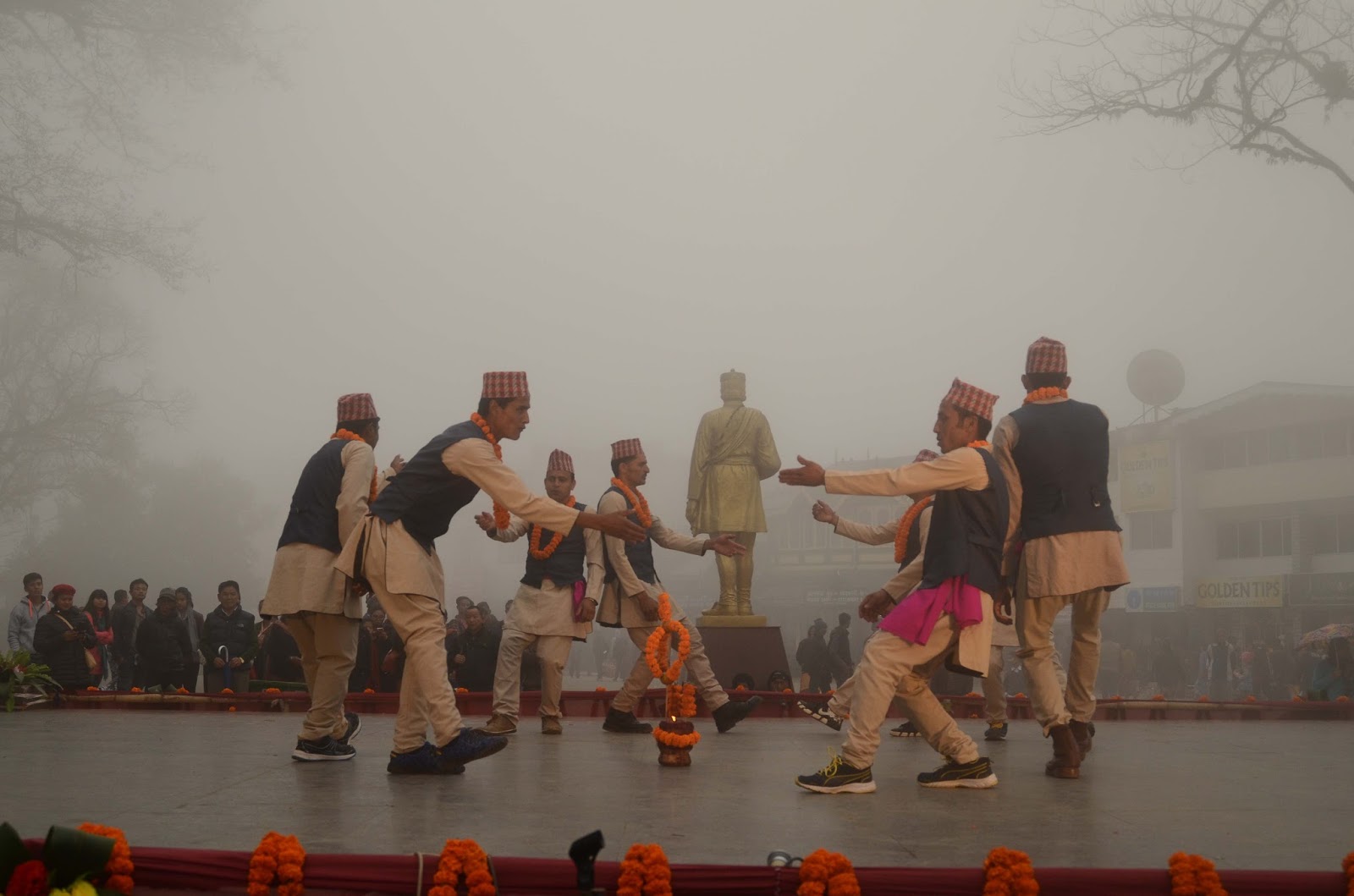
Members of Khas community presented two dances
with songs, Sangini (pic beow), a romantic one, and Balun (pic below), based on the Ramayana.

Three teams of the Sherpas presented three dances with songs. One was Sherpa Dance,
performed to please the groom and his family during weddings. Another was Nadin,
performed on auspicious occasions, while the third one was Sileba, which is a
dance to welcome guests (pic below).

The audiences also got
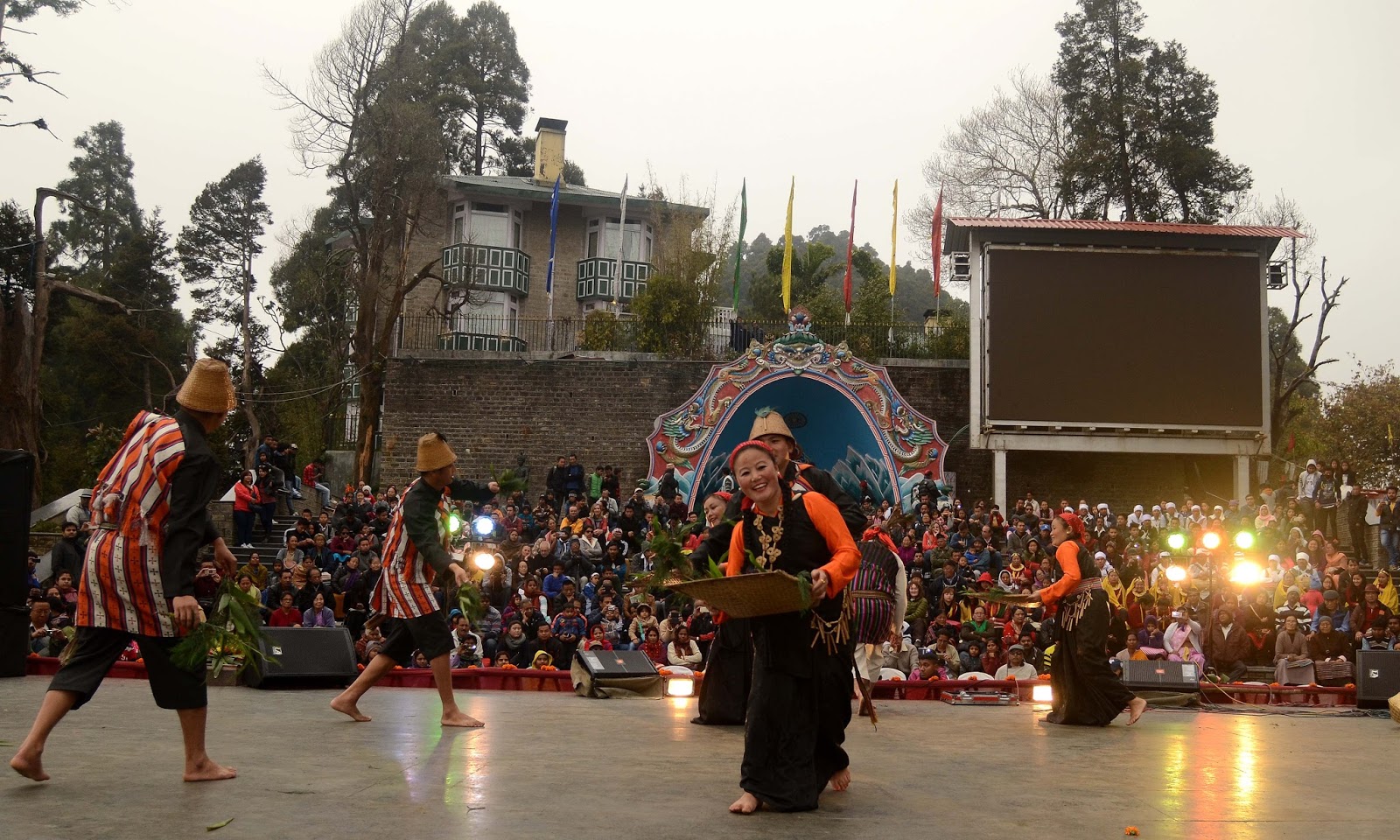
to catch a glimpse of three dances of the Lepchas,
each presented with a song. Naamban and Namaal Geet was one of them. It is
performed to celebrate New Year. Chyu Rum Faat Alak was another. It is a traditional
dance performed to show people’s respect to the Himalayas. Padam Baino was the
other one. It is a traditional dance with an earthy touch.
Bhutias showcased five dance
forms. Pow or Lappay Dance, performed to welcome guests, was one of them. There
were also Dukpa Kazokpa, a traditional song and dance for weddings and other
happy occasions, Lungpa Chung Zung, a traditional dance performed only by men,
Gosa Dho Dho, another traditional dance, and Dukpa, a traditional dance marked
for its colorful presentation.
Two troupes of the Newar community presented two dances with songs. One was Lakhe
Pnyakho or Lakhe (pic below), a vigorous mask dance performed during Indrayatra, while the
other was Kathi Pnyakho, performed at weddings and other such happy occasions.

The Kami community, better known for making
the traditional weapon called Khukhri, presented their own folk dance, Maruni.
The Damai community’s unique music genre,
Naumati Baja, captivated the audience. It was an ensemble of nine traditional
musical instruments. The artists first performed Dabling, which was followed by
Mangaldhun and Kheyali.
Swaying to the rhythms
of these earthy tunes and tapping their feet in sync with the dance steps,
tourists and locals alike lost themselves for a few hours and cherished the presentations.
Both the festivals were a grand success. But more than that, both the events will
be remembered for their zest for life and a rediscovery of the Hills communities’
ethnic roots and cultural moorings.
A glimpse of the audiences at the two festivals:


Comments
Post a Comment