
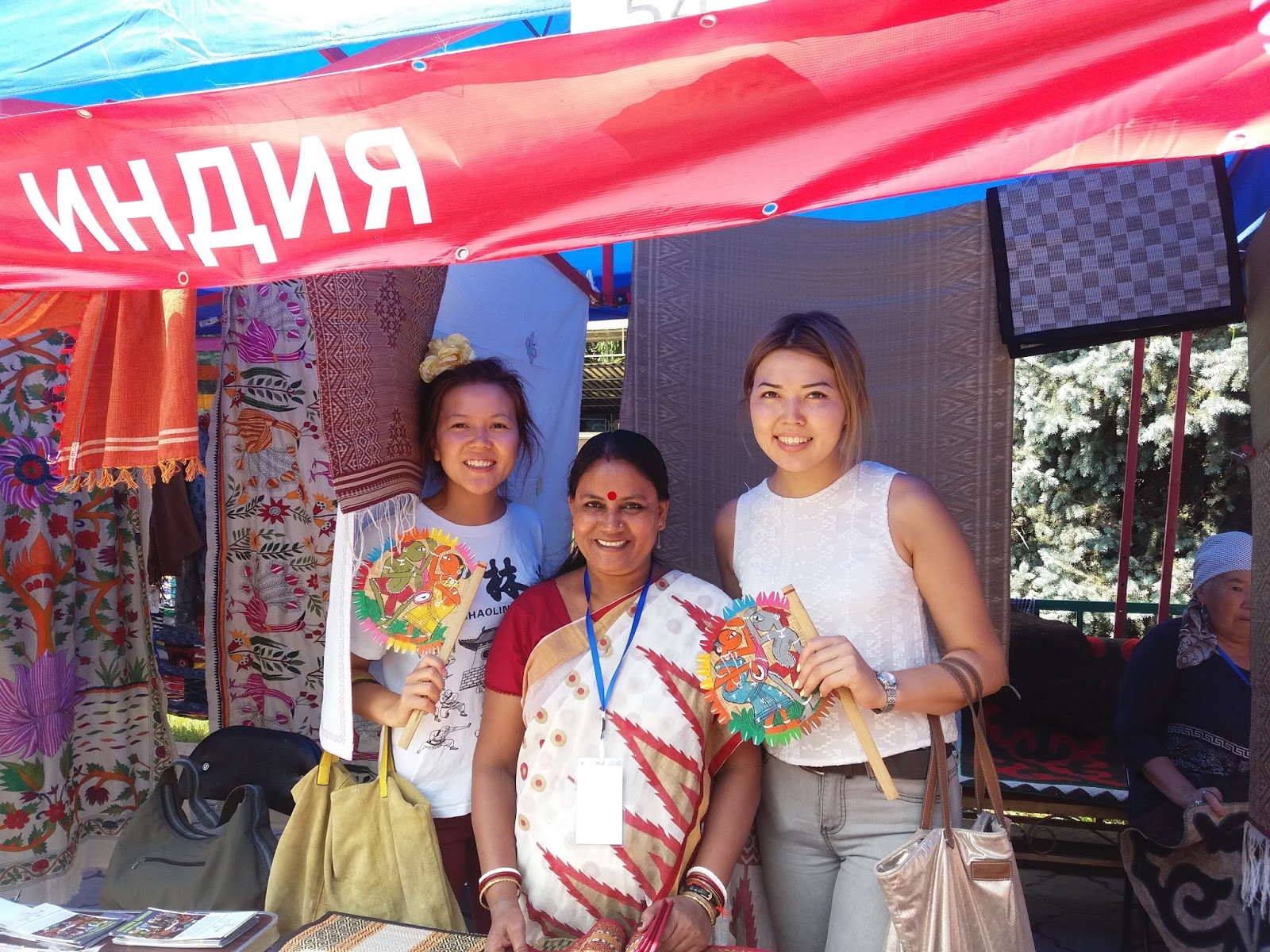

The OIMO Festival is a handicraft
fair in Kyrgyzstan that has been continuing the traditions of showcasing
handmade and natural products from Central Asian countries since past eleven
years. India being introduced for the first time in the year 2016, the OIMO invited
India with its wide array of handicrafts through AIACA, New Delhi. In connection
with 'Craftmark', we showcased the handicrafts of West Bengal where Madurkathi
was the star feature. The festival took place from July 29 to August 8, 2016.
In Bengal, the word Madur is a
generic for floor mats. Madurkathi is basically a weed used for making mats.
The weeds required for Madur are available in abundance in Sabang area of
Pashchim Medinipur. Mats have been an integral part of the social scene of
rural Bengal. The origin of the craft in West Bengal dates back to the Muslim
period, when 'Masland' mats of superfine variety with fine cotton as weft were
produced under royal patronage. Mats would be collected as revenue of the
Jaigirdari system. In 1744, Nawab Alibardi Khan issued a charter to the Jaigirdars
in this regard and as a result, it was obligatory to supply 'Masland' mats for
use in the collectorate.
The craft presently involves about 6000
artisans in Purba & Paschim Medinipur districts of West Bengal. A project of reviving and strengthening the craft by West Bengal Khadi & Village Industries Board is underway in the two districts covering 4432 artists.
Gauri Rana Jana, one of the award winning fine mat weavers represented Madurkathi tradition at the OIMO festival.
Gauri Rani's participation at the
festival initiated a direct understanding of a wider market for the product
directly by an artisan from the community. Interaction with clients, understanding
the demands of the market , its expectations and the ability to explain ones
product inspite of a great language barrier was what stood out as one of the key elements of the
visit. In her own words " I
noticed that the people were extremely interested in my craft. Small and
less expensive products sold well. Common people other than artists were also
keen to know the details of my craft and appreciated the process and the fact that it
is entirely handmade". Smiling she added " As
a representative of India, my attire attracted a lot of attention and I felt
like a celebrity of sorts where people were constantly requesting to be
photographed with me. I also walked the ramp to show my national attire to the
people of Kyrgyzstan, an experience which is entirely new to me".
 |
| Gauri Rani Jana on the ramp at the inauguration ceremony of the OIMO Festival |
The OIMO festival although
initiated the visit to the country, the organizers of the festival had planned
a craft village visit for team India. Artisans who specialized in making felt
and different product from the same along with artisans who build central Asian
nomadic tents called 'Yurt' were visited by the team. The first visit was to a
village named Kiziltuu, a village of artisans who involve in making the Yurt.
 |
| A Yurt |
 |
| Inside a Yurt
Making of an Yurt involves 5 craft processes all done by the
community at Kiziltuu. The processes being:
   |


The visit included stay at an
artisan's home. The family selected from this village were the Zheldenlbaevas with one of the master artisan Arzangul who is an expert felt maker and weaver.
The stay at the Zeldenbaevas proved to be an immense eye opener towards the
craft of Yurt making.
The second and the third visits
were to two separate artisan groups at Bokonbaevo, who engaged in felt making
and making traditional felt carpets called 'Shyrdak". Shyrdaks are made
from handmade felt of sheep wool.
The designs involved direct interactions with the
artisans of another craft community and learning the basics of the craft hands
on. It was something that Gauri found extremely satisfying and enriching an experience. She says " There
is lot to learn from these people in terms of behavior and of course their
craft. Their sense of responsibility towards others as well as their own work
is extremely inspiring. The way their whole village takes care of their craft
is very professional. This is something we can learn from them."
She adds " They have fantastic designs. I would love to absorb their sense
of imparting design into my craft "
As she continues to speak of her
experience, Gauri shares "It was a great experience to live with the
artisans of another country. I noticed that their craft includes extreme labour
just like ours. Some processes could be
identified with and some were completely new. There is a stark difference in
motifs and design value between our craft and theirs. I would like to learn
from them more (though I had participated in their process). I have also shared
my craft with them and they seemed quite interested to learn more about it.
They asked me about designs and motifs and appeared genuinely intrigued by
Madurkathi".
Gauri participated in
the various processes of felt making, weaving, construction and claims to
have returned to her country with a wider perspective of the world, its craft
and above all communities which involve in traditional craft making processes,
much like her own.

Comments
Post a Comment